Zynaverqolex
Quantum Sphere
Quantum Sphere
Couldn't load pickup availability
Share
1. Problem Statement
Large C++ applications can contain individually clear components that interact unpredictably. Shared information may be modified while another operation is reading or saving it. Errors across storage, processing, and concurrent tasks can obscure incomplete updates. Changes to interfaces may affect multiple components and complicate testing. Coherent design requires defined boundaries, lifetimes, and state.
2. Solution
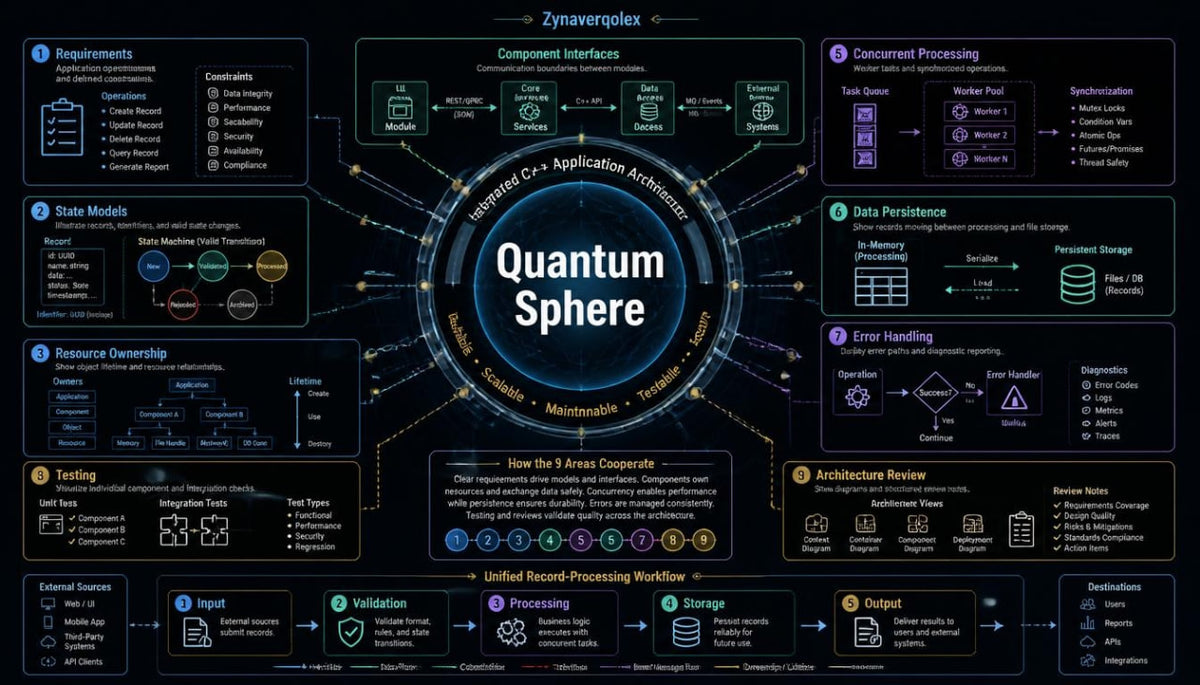
Quantum Sphere uses one evolving application model to connect earlier C++ concepts. Learners begin with requirements and define the responsibilities of its components. Each module introduces a design choice. Worked examples cover ownership, synchronization, persistence, failure handling, and verification with comparisons of alternative techniques. A review evaluates the architecture against documented scenarios.
3. What's Inside
Module 1 — Requirements and System Boundaries
Convert a scenario into operations, constraints, and testable behavior. Map records between services and storage.
Module 2 — Models and Invariants
Design record types, identifiers, and permitted state changes. Define rules for each operation.
Module 3 — Component Interfaces
Separate processing, storage, and coordination responsibilities. Define interfaces and review dependency direction.
Module 4 — Ownership Across Boundaries
Review value semantics, references, smart pointers, and RAII. Trace lifetime across tasks.
Module 5 — Concurrent Processing
Build a worker queue with clear task ownership and shutdown behavior. Examine synchronization, shared state, and ordering assumptions.
Module 6 — Persistence and Recovery
Represent records in a documented file format. Validate data and examine interrupted writes.
Module 7 — Error Paths and Diagnostics
Define error categories and trace failures across components. Add contextual diagnostic messages without exposing unrelated internal details.
Module 8 — Testing and Performance Review
Create checks for invalid records, repeated updates, concurrent operations, and interrupted tasks. Compare defined workloads.
Module 9 — Integrated Design Studio
Combine the application components into a record-processing system. Document interfaces, review state changes, and identify areas for revision.
4. Who Is This For?
Quantum Sphere is intended for learners who have studied classes, containers, resource management, modular architecture, and concurrency. It examines how these concepts interact in one extended C++ exercise.
5. What You'll Learn
-
Translate requirements into defined component responsibilities.
-
Model state changes with explicit invariants.
-
Choose ownership relationships across module boundaries.
-
Coordinate concurrent tasks and controlled shutdown.
-
Validate stored records and handle interrupted operations.
-
Trace errors across connected components.
-
Design tests for integration and unusual execution paths.
-
Explain architecture decisions using diagrams and written notes.
6. Guarantee
We offer a 30-day money-back guarantee on all paid digital courses and educational materials available through our store.
If you are not satisfied with your purchase, you may request a full refund within 30 calendar days of the original purchase date.
As our courses are delivered digitally, there is no need to return any physical items. Receiving, downloading, or opening the course materials does not affect your eligibility for a refund under this policy.
Refunds will be issued to the original payment method. Processing times may vary depending on your bank or payment provider.
Our 30-day money-back guarantee is provided in addition to your rights under applicable consumer protection laws and does not limit those rights.