Zynaverqolex
Vertex Sphere
Vertex Sphere
Couldn't load pickup availability
Share
1. Problem Statement
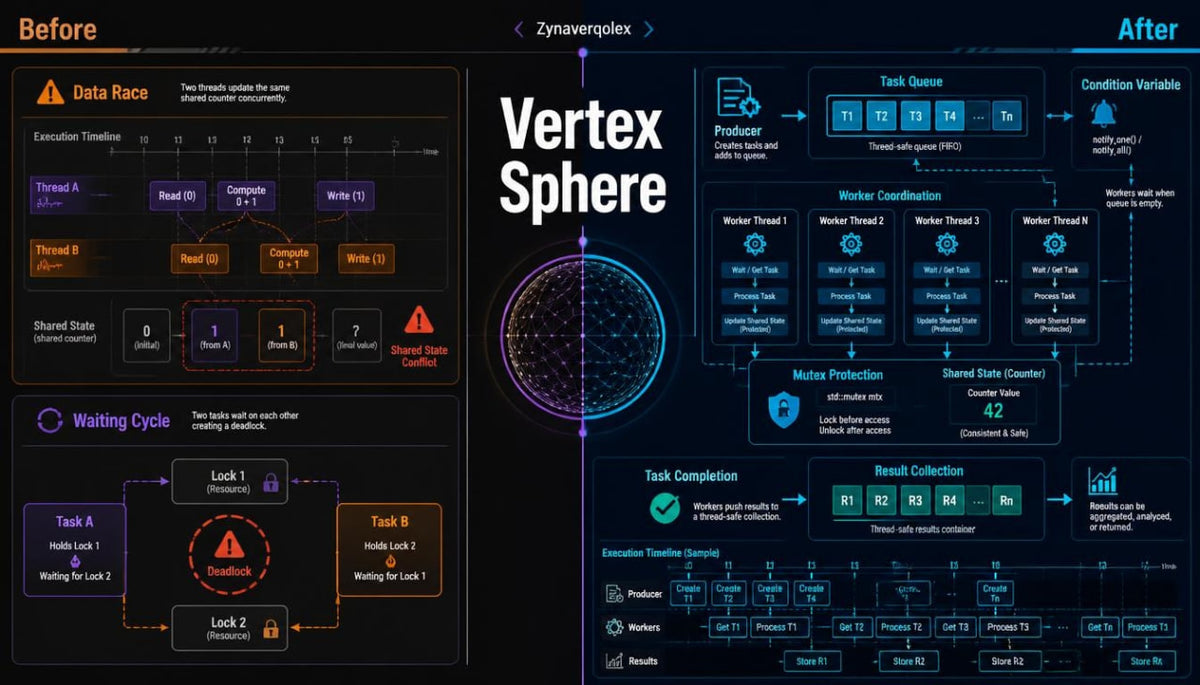
A program that handles several independent tasks may need to coordinate operations without losing track of shared information. When multiple threads modify the same data, results can depend on the order of execution. Poorly arranged locks can cause waiting cycles or block work longer than expected. Errors in concurrent code may appear only under particular timing conditions, making them difficult to reproduce. Developers need a clear way to reason about task ownership, synchronization, and behavior.
2. Solution
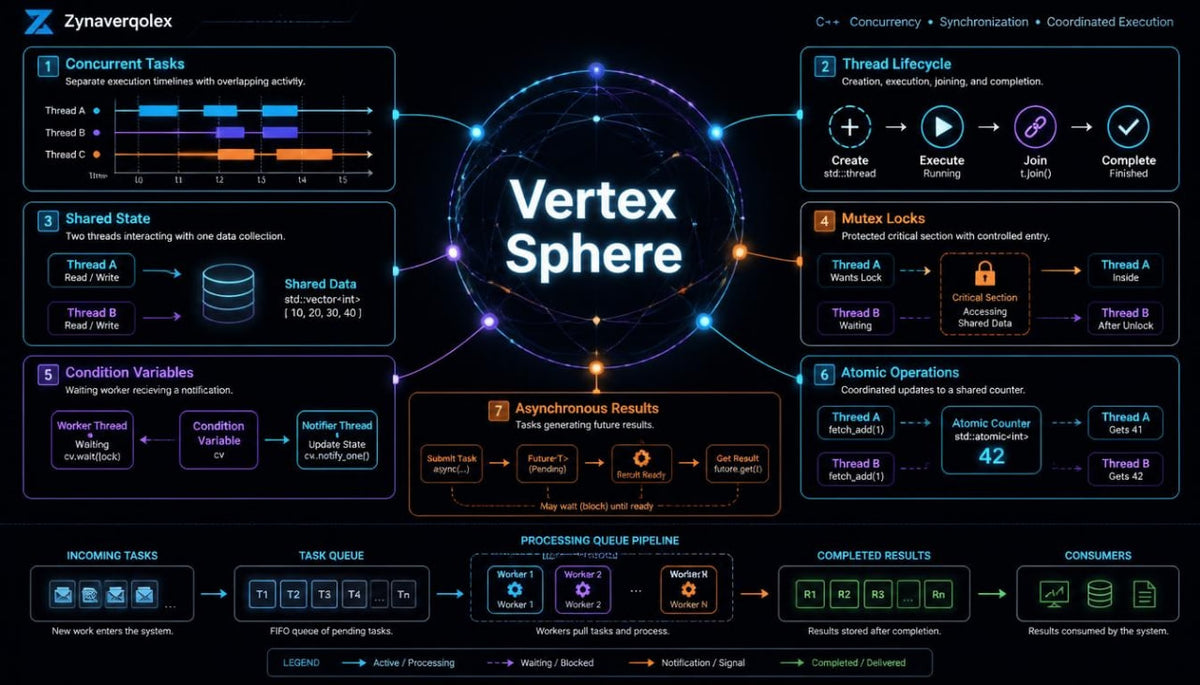
Vertex Sphere presents concurrency as a collection of defined responsibilities rather than a single programming technique. Learners trace thread creation, completion, and interactions before introducing shared mutable state. Examples explain how mutexes, condition variables, and atomic operations address distinct coordination needs. Guided exercises include boundary tests and measurements of alternative approaches. A final processing-queue study brings these concepts together in a documented C++ design.
3. What's Inside
Module 1 — Mapping Concurrent Work
Identify tasks that can run independently and operations that require ordering. Draw execution timelines and distinguish concurrency from parallel execution.
Module 2 — Creating and Completing Threads
Examine thread creation, joining, and lifetime. Review how references and object destruction affect task ownership.
Module 3 — Protecting Shared State
Study data races, mutexes, and scoped locking. Trace simultaneous updates to a shared collection and examine critical-section boundaries.
Module 4 — Coordinating with Conditions
Use condition variables and predicates to model waiting for new work. Explore notifications, spurious wakeups, and clear stopping rules.
Module 5 — Atomic Operations
Compare atomic counters with mutex-protected records. Examine when a single atomic operation is insufficient for coordinating several related values.
Module 6 — Tasks and Results
Explore asynchronous work, futures, and error propagation through result retrieval. Design functions with explicit input, output, and completion behavior.
Module 7 — Measuring and Diagnosing
Introduce timing measurements, repeatable workloads, and structured diagnostic records. Compare observations without assuming more threads improve every task.
Module 8 — Processing Queue Workshop
Design a small queue with producers, workers, and completion reporting. Document ownership rules, test shutdown behavior, and inspect possible waiting cycles.
4. Who Is This For?
Vertex Sphere is intended for learners comfortable with C++ classes, resource lifetime, standard containers, interfaces, and application architecture. It suits those studying concurrency through controlled examples before larger systems. Familiarity with references and exception handling will help when tracing shared state and task completion.
5. What You'll Learn
-
Distinguish concurrent execution from parallel execution.
-
Manage thread lifetimes and completion.
-
Identify data races and shared-state hazards.
-
Apply mutexes and scoped locking.
-
Coordinate workers using condition variables.
-
Compare atomic values with protected compound state.
-
Retrieve asynchronous results and examine errors.
-
Plan repeatable measurements for concurrent operations.
-
Review a work queue for shutdown and synchronization issues.
6. Guarantee
We offer a 30-day money-back guarantee on all paid digital courses and educational materials available through our store.
If you are not satisfied with your purchase, you may request a full refund within 30 calendar days of the original purchase date.
As our courses are delivered digitally, there is no need to return any physical items. Receiving, downloading, or opening the course materials does not affect your eligibility for a refund under this policy.
Refunds will be issued to the original payment method. Processing times may vary depending on your bank or payment provider.
Our 30-day money-back guarantee is provided in addition to your rights under applicable consumer protection laws and does not limit those rights.